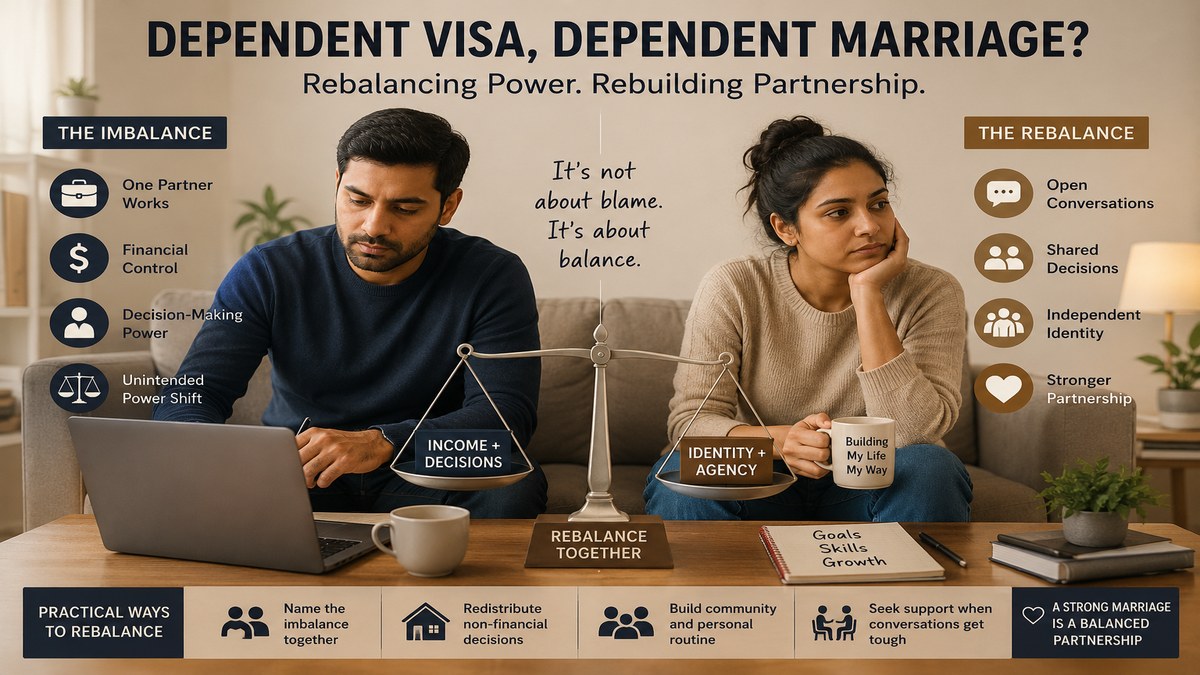
It rarely gets said out loud, but it's one of the most common dynamics in NRI marriages: one partner's visa status means they can't work right away — sometimes for months, sometimes for years — while the other partner holds the job, the income, and often, without anyone intending it, a disproportionate amount of decision-making power in the marriage.
The Power Imbalance Nobody Plans For
Most couples don't choose this dynamic; it's simply a byproduct of visa categories and immigration policy. But unexamined, it can quietly reshape a marriage's power balance in ways that create real resentment on both sides — for the dependent spouse, and for the working spouse who may feel an outsized weight of responsibility.
Book Marriage counseling for Indians in USA
How Dependent Visa Status Quietly Changes a Marriage
Financial dependency and decision-making power
When one partner controls all household income, even well-intentioned couples can drift into a pattern where financial decisions, big or small, default to the earning partner — eroding the dependent spouse's sense of agency over time.
Loss of professional identity
For a spouse who built a career, qualifications, or professional identity before the move, an inability to work isn't just inconvenient — it can feel like a real loss of self, deserving acknowledgment rather than being framed as a temporary inconvenience.
Isolation while the working spouse builds a life outside the home
The working partner builds a routine, colleagues, and a sense of place through their job. The dependent partner is often left to build all of that from zero, alone, which can compound the loneliness already common in the early years abroad.
Signs a Dependent Visa Is Affecting Your Relationship
Common signs include the dependent spouse feeling like they need “permission” for purchases or plans, the working spouse feeling solely responsible for every decision and exhausted by it, or both partners avoiding the topic entirely because it feels uncomfortable to discuss directly.
How Couples Can Actively Rebalance the Dynamic
Naming the imbalance out loud, together
Simply acknowledging “our current setup isn't equal right now, and that's the visa situation, not a reflection of our partnership” can meaningfully shift how both partners experience it.
Redistributing non-financial decision-making power
Where financial control can't be immediately equalized, couples can deliberately rebalance other forms of decision-making — household choices, social plans, long-term decisions — so the dependent spouse retains real agency.
Building the dependent spouse's independent community and routine
Volunteering, classes, professional associations, or community groups can give the dependent spouse a sense of structure and identity outside the marriage, which measurably reduces strain on the relationship itself.
Online marriage counseling for NRIs
How NRI Marriage Counseling Helps Couples Navigate Dependent Visa Challenges
NRI marriage counselling(https://www.coachsuchetaa.com/nri-marriage-counseling) helps couples name and actively rebalance this dynamic before it hardens into long-term resentment, with practical strategies suited to the specific visa and career stage each couple is navigating. This is one of the more sensitive topics we address within Coach Suchetaa's NRI marriage counseling program(https://www.coachsuchetaa.com/nri-marriage-counseling), with both joint and individual sessions available.
Frequently Asked Questions
Q: Is this power imbalance avoidable?
It's rarely fully avoidable given how dependent-visa categories work, but its impact on the relationship is very manageable when both partners actively name and address it rather than letting it go unspoken.
Q: My spouse says I have nothing to complain about since they're “doing all the work.” How do we talk about this without it turning into a fight?
This is exactly the kind of conversation a neutral, trained third party can help significantly with, since both perspectives are valid and the goal isn't to assign blame but to find a structure that feels fair to both partners.
Q: Does this get easier once the dependent spouse can work?
Often, yes — but the patterns established during the dependent period can persist even after both partners are working unless they're actively addressed, which is why naming the dynamic early matter
Marriage counseling across time zones
Coach Suchetaa(Lead Relationship Coach and India’s No.1 Marriage Counselor)